Venus Grading System (VGS®)
Introduced in 1996 through extensive research, the proprietary Venus Grading System® (VGS®) was created to bring clarity and consistency to diamond grading. By expanding the simple 4Cs into precise, meaningful sub-grades, VGS® offers a deeper and more transparent understanding of every diamond. This commitment to accuracy led us to pioneer Single-Piece Packaging and, in 1997, to launch venusjewel.com, redefining how polished diamonds are bought online. Today, most of our customers confidently buy online, supported by a system built on the enduring credibility of VGS®.

Venus Grading System provides carat weight measurements up to the third decimal place, surpassing the industry standard of two decimal places.

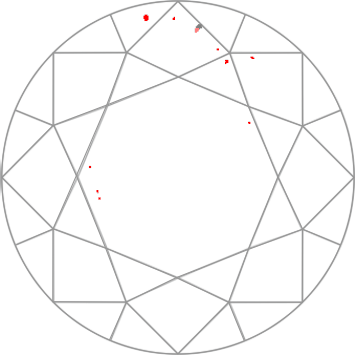
For each weaker clarity, the visual difference between the two clarity grades increases. With experience, experts can judge whether a stone, for instance, qualifies as a better SI1 or a weaker SI1.

As the color scale progresses from D to Z, the range between consecutive color grades becomes wider. To report these color range accurately, VGS assigns ‘Better’ (+), ‘Standard’ ( ), and ‘Weaker’ (−) sub grades to each color grade. This expands the standard 17 color grades into 34 color grades, offering greater precision.
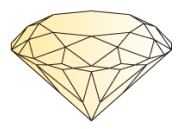
The VGS reports the presence of any color tinge (hue/shade) other than white or yellow as a Color Shade. VGS classifies these variations into 74 distinct color shades, with the most commonly observed shades listed below.
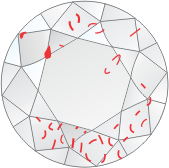
This grade reports distribution and hardness of inclusion in the diamond.